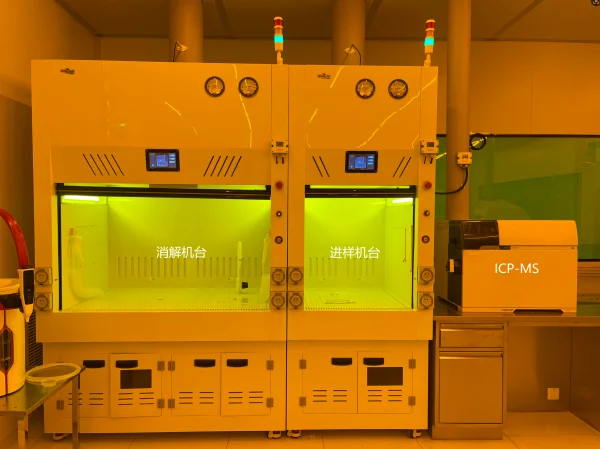
In ultra-trace analysis within the semiconductor industry, particulate matter, cleanliness levels, and ion outgassing are core requirements for ensuring data accuracy and preventing sample contamination. These requirements directly determine whether equipment can be used for analyzing critical items such as high-purity chemicals and metal contamination on wafer surfaces.
Below are detailed technical specifications addressing these three points:
🧹 Particle Control Specifications
1. Equipment-Specific Particle Control:
· Design and Materials: The instrument housing and internal structure must utilize smooth, non-shedding materials. Moving components (e.g., sample arms, needle holders) should be designed to minimize friction, preventing the generation of metal or plastic particles.
· Internal Gas Pathways: All positive-pressure or purge gas pathways (e.g., nebulizer gas lines, nebulizer chamber exhaust lines) must be equipped with < 0.1 µm particle filters at their inlets to ensure the cleanliness of incoming gases (typically high-purity argon or nitrogen).
· Vibration control: For equipment like microwave digesters, operational vibrations must not cause internal connections to loosen or generate particles.
2. Particle control during sample processing:
· Digest completeness: Microwave digestion protocols must ensure complete dissolution of samples (especially silica-based or ceramic particles). Undissolved suspended particles must not enter subsequent analysis, as they can clog nebulizers and cause unstable signals.
· Pre-injection processing: After transferring digested samples to autosampler vials, employ ultra-pure centrifugation or membrane filtration (using 0.22 µm or 0.45 µm PTFE filters) as needed to remove residual particles.
⚡ Cleanliness Class Specifications
1. Instrument Operating Environment:
· ICP-MS instruments and their associated sample introduction and digestion systems are strongly recommended to be housed in a Class 5 (Class 100) or higher cleanroom environment. This is fundamental for controlling environmental particulate contamination and airborne molecular contaminants (AMC).
2. Internal Instrument and Consumable Cleanliness:
· Factory Standard: For instruments designed for semiconductor applications, core modules in contact with samples (e.g., nebulizer chambers, injection needles, digestion vessel liners) must undergo final assembly, cleaning, and packaging in an ISO Class 4 (Class 10) or superior environment.
· Consumable Certification: All consumables (pump tubing, sample tubes, digestion vessels, reagent bottles) must provide particle count test reports. For example, PFA reagent bottles used for ppt-level analysis must have clearly defined residual particle specifications after cleaning.
🧪 Ionic Leachables Control Specifications
This represents the most stringent requirement for high-purity plastic (PFA/PTFE/PP) components, referring to the slow dissolution of trace metal ions from materials when immersed in acids or solvents.
1. Ultra-Low Background Material Certification:
· All sample flow path components (digestion vessels, lids, transfer tubes, nebulizers, nebulization chambers, central tubes) must use “semiconductor-grade” or “ultra-high purity (UHPLC/MS-grade)” certified PFA or PTFE materials. Suppliers must provide an “Acid Wash Certificate” explicitly detailing the leaching levels of key metal ions (e.g., Li, Na, Mg, Al, K, Ca, Cr, Fe, Ni, Cu, Zn, Pb, U) under specified temperature, time, and acid medium conditions (e.g., high-purity nitric acid, hydrochloric acid, hydrofluoric acid). Typically, leaching concentrations for each element must be below 10 ppt.
2. System Validation and Monitoring:
· Blank Validation: After acceptance testing or replacement of critical components, a rigorous “full-process blank” experiment must be performed. This involves a complete digestion cycle using ultrapure acid (simulating actual procedures) – acid removal – volume adjustment – injection – followed by blank value determination. Ideally, blank signals for most metals should be below three times the instrument’s method detection limit.
· Routine Monitoring: Establish periodic blank testing protocols to monitor system background stability, which is critical for detecting ion leaching contamination or environmental pollution.
🛡️ Integrated Control: Building a Clean Analytical Workflow
To meet the above requirements, the entire analytical workflow must be systematically constructed:
Control Element Specific Requirements & Measures
Operating Environment ISO Class 5 (Class 100) cleanroom with controlled temperature and humidity; operators must wear full cleanroom suits.
Reagents & Gases: Use BV-III grade or higher ultra-pure acids, 18.2 MΩ·cm ultrapure water, and high-purity argon/nitrogen gas ≥99.999% purity.
Consumable Preparation: All PFA vessels must be immersed in hot ultra-pure acid (e.g., 1:1 HNO₃) for several days within the cleanroom, then rinsed with ultrapure water before use.
Sample Processing: Use certified ultra-low background digestion vessels during the digestion process. The procedure must ensure complete sample dissolution.
Equipment Maintenance: Regularly clean components such as nebulizers, nebulization chambers, and pump tubing with ultra-pure acid solution according to protocols. Record blank values after maintenance.
In summary, meeting the semiconductor industry’s stringent requirements for particulate matter, cleanliness levels, and ion leaching hinges on: utilizing ultra-low background certified semiconductor-grade components, operating within high-grade clean environments, and establishing a comprehensive blank monitoring system covering reagents, gases, operations, and maintenance.
If you require optimization recommendations for pretreatment processes targeting specific samples (e.g., high-purity hydrogen peroxide, wafer surface extractions, CMP slurries), I can provide more detailed information.